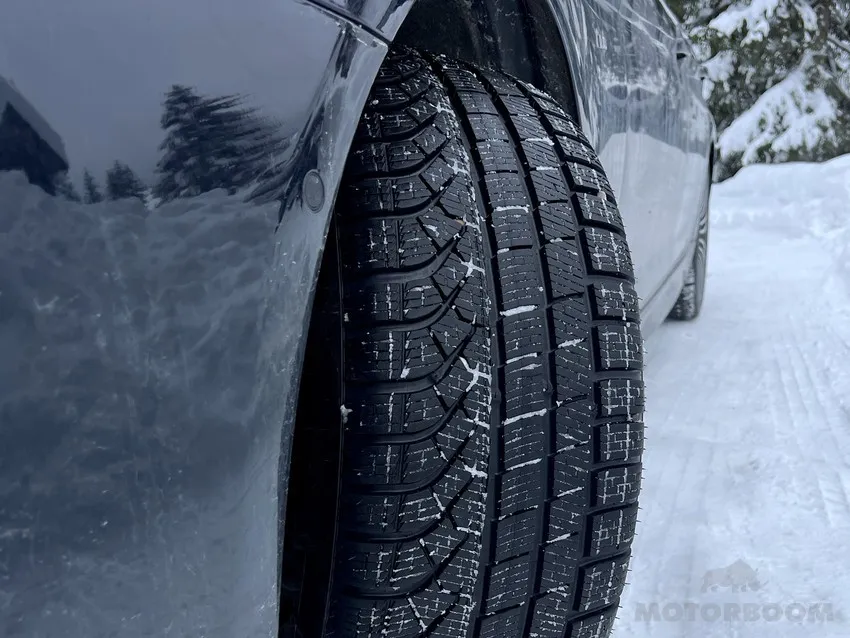
From 15 November to 1 April, cars, buses and trucks in Montenegro must use winter tyres not just when there is snow, ice or black ice on the road.
Fines range from €150 to €1,000 for drivers and from €1,500 to €6,000 for legal entities. In addition, the Ministry makes winter tyres mandatory on certain roads regardless of the weather. The season has already begun: below is a breakdown of what exactly the Law on Road Traffic Safety requires and what drivers and legal entities that own vehicles risk.
When are winter tyres required?
The Law sets the period from 15 November to 1 April and applies to all vehicles of categories M and N (Art. 132). Under the international classification, category M covers vehicles for the carriage of passengers (passenger cars, buses), and category N covers goods vehicles.
The rule is tied not only to the calendar but also to the weather. Winter tyres are required when driving in “winter conditions”, that is, during snowfall or when snow, ice or black ice is on the carriageway. The exception is roads on which the requirement has been introduced by a special order (see below).
Winter tyres and equipment
The Law sets 3 main conditions for the use of special equipment on vehicles in winter (Art. 132):
- winter tyres on all wheels, not only on the drive wheels;
- minimum tread depth of 4 mm;
- compliance with other winter equipment requirements (the vehicle must carry a set of snow chains of the appropriate size, a snow-clearing tool, etc.).
Police powers
If a driver is travelling on a road or road section with snow or black ice without winter equipment, a police officer may order the driver to use special winter equipment (Art. 303). If the driver fails to comply with the order, the police officer will remove the vehicle from traffic. This means the journey in that vehicle is interrupted: it will not be possible to continue until the violation has been remedied.
Fines for drivers and legal entities
The fine for driving without winter tyres in winter conditions is up to €1,000 for a driver and up to €6,000 for a legal entity.
Who | What is considered an offence | Penalty | Legal basis |
Legal entity | Orders or permits vehicles to be driven in winter conditions without winter tyres on all wheels or without other winter equipment | €3,000–6,000 | Art. 315, point 8a (Art. 132, paras. 1 and 3) |
Driver | Drives a vehicle in winter conditions without winter tyres on all wheels or without chains | €500–1,000 or imprisonment of up to 60 days | Art. 318, point 10 (Art. 132, paras. 1 and 3) |
Legal entity | Orders or permits its vehicle to be driven without winter tyres | €1,500–4,000 | Art. 317, point 14 (Art. 132, paras. 4 and 5) |
Driver | Drives a car without winter tyres meeting the minimum tread depth requirement of 4 mm | €150–300 | Art. 322, point 30 (Art. 132, paras. 4 and 5) |
Driver | Drives a car without special winter equipment | €150–300 | Art. 322, point 31a (Art. 132, para. 4) |
For certain types and categories of vehicles, on a specific road or road section at a specific time, an obligation to use winter tyres may be established even if there are no winter conditions on that road (Art. 132, para. 4). The period and the list of roads or road sections are determined by the Ministry by order, after obtaining the prior opinion of the state administration authority responsible for transport.
On the sections named in the order, you cannot rely on the weather: on dry asphalt, driving without winter tyres will still be an offence.
Roads where winter tyres are mandatory
Order of the Ministry of the Interior No. 01-222/26-50814/4 of 6 November 2026 defines the list of roads on which the winter equipment requirements apply regardless of weather conditions for the 2026–2027 season. In total, the list covers 43 road sections in Montenegro with a combined length of about 1,666 km.
Road designation | Road or road section | Length, km |
A-1 – motorway | Smokovac – Mateševo 1 | 42.0 |
M-2 | Petrovac – Sotonići | 22.3 |
M-8 | Lipci – Grahovo – Vilusi | 38.6 |
M-10 | Carev laz – Cetinje 1 – Budva | 44.4 |
M-7 | Nikšić (Interchange 2) – Vilusi – Ilino brdo (border with Bosnia and Herzegovina) | 35.8 |
M-3 | Šćepan Polje (border with Bosnia and Herzegovina) – Plužine – Jasenovo Polje – Vir – Nikšić (Grebice – Interchange 2 – Interchange 1) – Danilovgrad | 114.2 |
M-2 | Bioče – Mioska – Kolašin – Mojkovac – Slijepač most – Ribarevina – Bijelo Polje (bypass) – Barski most (border with the Republic of Serbia) | 123.0 |
M-5 | Ribarevina – Berane – Rožaje – Dračenovac (border with the Republic of Serbia) | 77.8 |
M-6 | Ranče (border with the Republic of Serbia) – Trlica – Pljevlja – Mijakovići – Đurđevića Tara – Žabljak bypass – “Ivica” tunnel – Šavnik – Kruševice – Jasenovo Polje | 126.4 |
M-9 | Vilusi – Petrovići – Deleuša (border with Bosnia and Herzegovina) | 20.8 |
M-13 | Cetinje 1 – Ćeklići – Lješev stub – Čevo 1 – Čevo 2 | 22.6 |
M-14 | Slijepač most – Tomaševo – Pavino polje – Vrulja – Mijakovići | 49.2 |
R-19 | Mateševo 2 – Bare kraljske – Trešnjevik – Andrijevica | 34.7 |
R-2 | Berane – Andrijevica – Murino – Plav – Gusinje – Grnčar (border with the Republic of Albania) | 54.6 |
R-9 | Murino – Bjeluha (border with the Republic of Kosovo) | 34.3 |
R-18 | Pljevlja – Gradac – Šula | 35.8 |
R-1 | Ćeklići – Čekanje – Njeguši – Trojica | 38.1 |
R-15 | Vladimir – Ostros – Virpazar – Rijeka Crnojevića – Donji Ulići | 84.1 |
R-17 | Čevo 2 – Riđani | 35.0 |
R-7 | Vir – Krstac (border with Bosnia and Herzegovina) | 42.7 |
R-14 | Danilovgrad – Čevo 1 | 27.5 |
R-8 | Lješev stub – Resna – Grahovo – Nudo (border with Bosnia and Herzegovina) | 56.0 |
R-20 | Virak – Bukovica – Tušina – Šavnik | 37.7 |
R-21 | Mioska – Dragovića Polje – Semolj – Krnja Jela – Boan – Tušina | 39.9 |
R-13 | Bioče – Mateševo – Kolašin | 58.9 |
R-6 | Most Zeleni – Vuča (border with the Republic of Serbia) | 29.0 |
R-5 | Rožaje – Kula – Stubica (border with the Republic of Kosovo) | 22.4 |
R-11 | Budimlja – Podvade – Kalače | 35.9 |
R-12 | Podvade – Gusare – Bioča | 11.0 |
R-12.1 | Gusare – Petnjica | 1.6 |
R-16 | Plužine – Trsa – Pošćenski kraj | 44.7 |
R-3 | Pljevlja – Dajevića han – Metaljka (border with Bosnia and Herzegovina) | 37.2 |
R-4 | Dajevića han – Čemerno (border with the Republic of Serbia) | 10.3 |
R-10 | Đurđevića Tara – Mojkovac | 46.0 |
R-24 | Buča – Lubnice – Jezerine | 24.0 |
R-25 | Cetinje 2 – Ivanova korita – Međuvršje – Krstac | 24.3 |
R-25.1 | Međuvršje – Lovćen | 3.0 |
R-26 | Vrela – Njegovuđa | 3.6 |
R-28 | Bar (Biskupada) – Sutorman – Virpazar 3 | 31.2 |
R-23 | Bar (Ćafe tunnel) – Kamenički most – Krute | 14.4 |
Access roads to ski centres | “Bablja greda” – “Kolašin 1450” Ski Centre – “Kolašin 1600” Ski Centre | 11.0 |
Žabljak – “Savin kuk” ski slope | 3.3 | |
Nikšić – Vučje | 17.0 |
MotorBOOM recommends
- Check all four wheels. Winter tyres are required on all wheels, and the tread depth must be at least 4 mm.
- Take your route into account. On sections covered by the Ministry’s order, winter tyres are required even on a clear road.
- Keep track of the current order. The period and the roads are set by the Ministry, so the list may change.
- A company is liable on a par with the driver. Whoever controls a vehicle or permits it to be driven without winter tyres (company fleets, carriers) risks a fine of up to €6,000.
- Comply with police orders. Refusal will result in the vehicle being removed from traffic.
Safety begins with the responsibility of every driver behind the wheel. Let’s make Montenegro’s roads safer together!