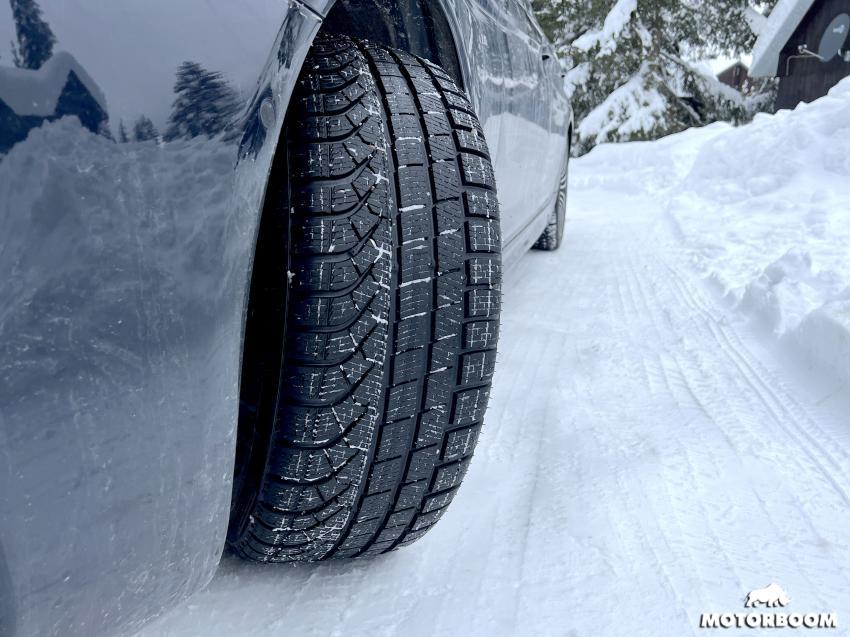
In Montenegro, the use of winter tyres is mandatory for vehicles from 15 November to 31 March. Tyre manufacturers recommend replacing summer tyres with winter tyres.
In Montenegro, the use of winter tyres is mandatory for vehicles from 15 November to 31 March. Tyre manufacturers recommend replacing summer tyres with winter tyres.
How to Choose Winter Tyres Properly?
Several factors play a role here, namely: the type of tyre, the operating conditions and, ultimately, the amount the driver is willing to spend.
To choose winter tyres correctly, you need to pay attention to a number of factors that matter when buying them:
a) country of manufacture and tyre brand;
b) date of manufacture;
c) studded or non-studded;
d) tyre wear resistance;
e) load index;
f) speed rating.
Winter tyres are also divided into two types:
- “European” – designed for use in regions with “mild” winters. In such regions the air temperature usually stays between 0 °C and +5 °C;
- “Scandinavian” (“Nordic” or friction tyres) – used for driving in severe frost and deep snow. They are made of a soft compound, and the tall tread with its special pattern provides stability even on icy or snow-covered stretches of road.
“European”-type tyres are in some ways similar to summer tyres. They have relatively robust tread blocks with grooves between them. These grooves channel away water or slush (a snow-and-water mixture), thereby improving road grip. The tread areas are also noticeably harder than on “Scandinavian”-type tyres. You can tell this even by touch.
“Scandinavian”-type tyres are characterised by numerous thin, zigzag grooves in the tread blocks, known as “sipes”. Under load, the tyre deforms where it meets the road and the sipes shift relative to one another. This increases road grip despite ice or snow. An additional feature of “Scandinavian” tyres is an angular section at the transition from the sidewall to the tread. This improves the vehicle’s traction in loose snow.
Studded tyres can be considered a special type. When choosing them, pay attention not only to the water-evacuating grooves that are important for winter tyres, but also to the design of the studs. The more effective ones are not round but have a more complex shape: a hard core in an aluminium casing. Their placement on the tyre also matters. The more rows of studs and grooves, the better the tyre’s stability on slippery surfaces. Studded tyres have drawbacks as well as advantages. Non-studded tyres reliably maintain braking distance and steering line on dry or wet asphalt, whereas studded tyres will slip, reducing driving safety.
Tyre Markings
Modern tyre models (studded and non-studded) have acquired very similar characteristics and very similar markings. The “M+S” or “M&S” (Mud + Snow) marking stands for “mud plus snow”. This marking indicates that the tyres are winter or all-season tyres. However, some summer tyres for SUVs also carry the “M&S” mark. These are not winter tyres: the “M&S” symbol indicates the tyre’s improved off-road capability. For crossovers and SUVs, it is better to buy specialised tyres, which are usually marked “SUV”. A winter tyre is additionally identified by the pictogram (snowflake), which means the product is intended for use in winter conditions.
Manufacturer
When buying a new set of tyres, it is worth asking which company made them, since many automotive groups have subsidiary plants in other countries. That way you can choose a company you trust.
Shelf Life
The shelf life of a winter tyre in storage is up to 6 years. The date of manufacture is shown on the sidewall as four digits: the first two are the week number and the last two are the year of manufacture (0420 – the fourth week of 2020). It is also very important to compare the actual load and speed indices marked on the tyre with the indices recommended for your vehicle.
Snow Chains and De-icing Agents
Montenegro’s traffic regulations require drivers to carry snow chains in the boot in winter. These chains will get a driver out of trouble in sudden snowfall or black ice. Experienced motorists also stock up on a certain amount of granular de-icing agent, which is sometimes needed when leaving an ice-covered parking space.
Frankly, choosing winter tyres is not always easy, especially the first time. If you have any doubts about your choice, it is better to ask professionals for help. They can help you pick exactly the tyres that will best suit your car in winter.